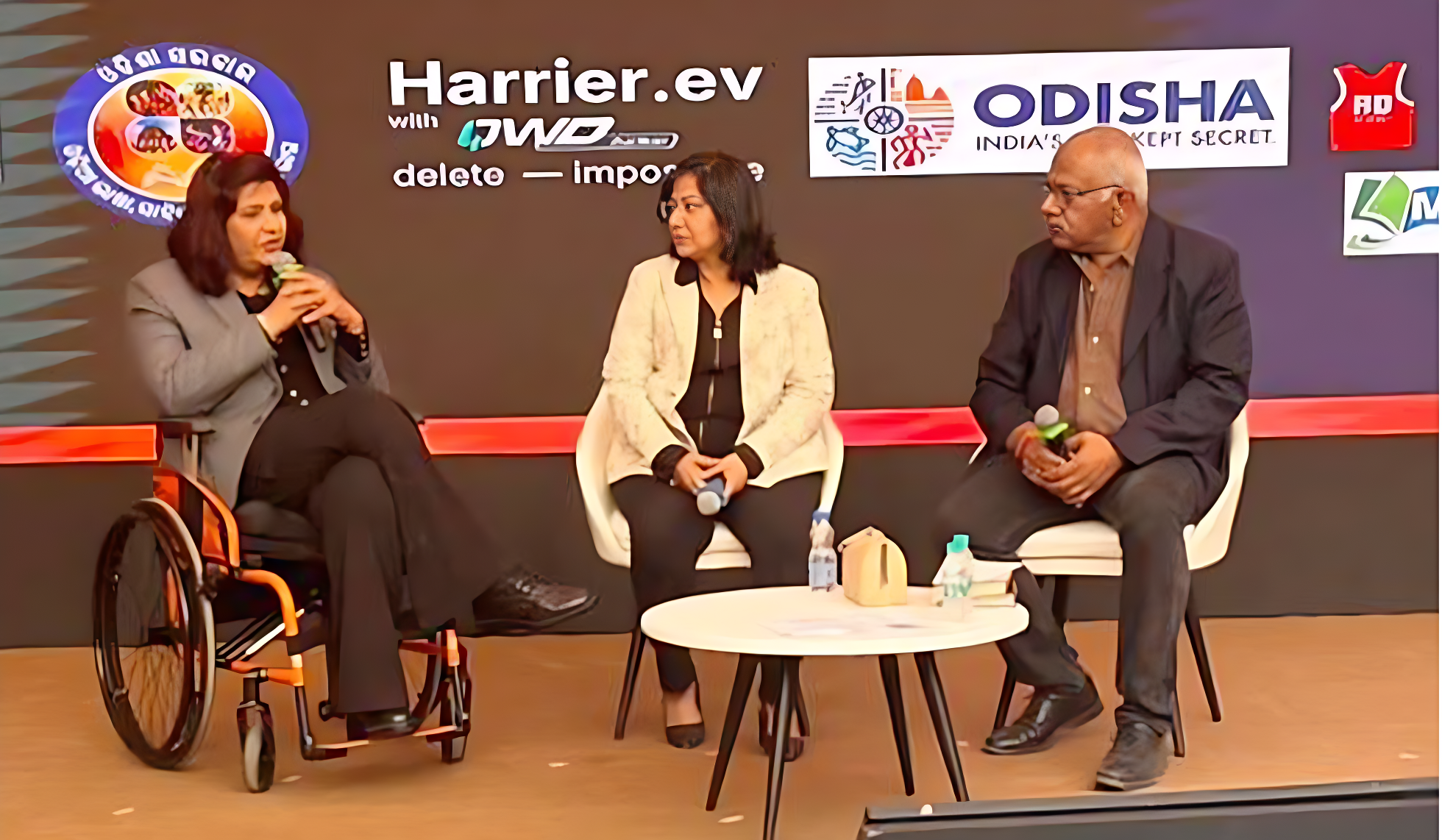
New Delhi: The stage at Session 7 of the Ekamra Sports Literature Festival became a space of profound honesty as Deepa Malik and her co-author, Soni Sangwan, discussed their book, Bring It On. Deepa, the first Indian woman to win a medal at both the Asian Para Games and the Paralympics, shared not just her medals, but the mindset that forged them.
Guiding the discussion was Sports Communication Professional G. Rajaraman, whose four decades in sports journalism brought warmth and focus. The session quickly moved beyond simple accolades to explore the sheer courage, choices, and perseverance behind Deepa’s remarkable journey from living with paralysis to becoming a national icon.
The Four Aces: Athlete, Activist, Adventurer, Author
Rajaraman structured the conversation around what he called Deepa’s “Four Aces,” the distinct roles she has excelled in: Athlete, Activist, Adventurer, and Author. He began by asking about the book’s defiant title.
Deepa revealed that the title was a consensus reached with Soni and the publisher after reviewing the draft.
Deepa Malik: “The challenges just don’t end one after the other… Nothing has been smooth right from adapting and accepting paralysis in my life… I’ve become such a solution finder to everything that I don’t get scared or perturbed or shaken up by any challenge coming my way, and this is the mantra: ‘Okay, bring it on, we’ll find a solution.'”
Soni Sangwan explained the writer’s challenge: how to tell a story whose ending—the Paralympics silver medal—was already known. The solution was to focus on the relentless struggle.
Soni Sangwan: “When you hear her tell her story, you realize that the smiling Deepa we see here today… every step was a challenge… Every small thing she had to fight for. She had to fight for something like the right to drive a car… That’s just one very, very small instance of where she says, ‘Okay, you took away the key. Bring it on. I’m going to show you a way that I can get around every challenge that comes my way.'”
Dressing Up the Narrative: Honesty with Restraint
Rajaraman introduced the concept of autobiography as a record of one’s existence and asked Deepa if her book was 100% true, or if she held anything back. Deepa admitted she had postponed writing for a long time, wary of hurting sentiments.
Soni offered an elegant analogy that defined their approach:
Soni Sangwan: “Deepa, when you step out of the house, everybody knows what a human body looks like… but you still dress up, right? You wear clothes. You don’t walk out naked… We will make the book a little dressed up which is presentable. We are not going to hurt sentiments. We are not going to make it a book of complaints.”
Deepa emphasized that she wanted the book to be one of solutions and inspiration, choosing to focus on those who contributed positively to her journey, rather than dwell on the ignorance or gender bias that created obstacles.
Soni detailed the conscious process of restraint in writing, filtering out irrelevant incidents or those involving people who have since changed:
Soni Sangwan: “There were days when during the narrations we would have to stop because both of us were in tears… but then we both calm down. Next day we say, ‘Yeah, we can’t put that in because the people involved are still alive.'” Deepa Malik: “One thing in life which I’ve learned from her and which I also firmly believe is… life is too short to hold grudges. It’s best to just take the positive lessons… and just move on.”

A Journalist’s Discretion and a Second Book
Deepa praised Soni’s journalistic skills, noting they were a massive aid, not a hindrance. Soni’s research helped recall correct dates, names of rivals, and distances that Deepa herself had only vaguely remembered from the early, naive days of her career.
The co-authors agreed that the aim was never a “sensational tell-all” but an inspirational guide for diverse readers.
Soni Sangwan: “This is a book not just for sports people… but people who can learn so much from her story. So keep the book on a positive and inspirational mode rather than a sensational or a tell-all kind of a book.”
Rajaraman pressed Deepa on why she consciously stopped the book at her Paralympic medal win, excluding her transformative experience as an administrator and President of the Paralympic Committee of India (PCI).
Deepa offered a tantalizing promise:
Deepa Malik: “If you read the book, it ends at that medal and me coming home with the medal… I think we can look for a book two…. When the athlete transcends into an administrator, that’s another journey of learning, another journey of experiences, and that also needs to be written.”
The discussion on writing proved to be a cathartic experience for Deepa, allowing her to revisit difficult emotions, and through a new lens, find closure, forgive, and even ask for forgiveness from people involved in past unpleasant incidents.
A Life-Saving Bond and Gratitude
The final exchange focused on the bond formed between the writer and the subject. Deepa confirmed that Soni’s ability to relate to every emotion stemmed from their shared background as army kids and army wives.
Deepa Malik: “When I read the book myself when it came for the first draft, I was surprised. It was as if it is just replicating my narrations. It’s not even changed the language.”
She insisted on Soni’s name being credited as co-author, saying, “You’ve done such a fantastic job… You haven’t tried to put a Sony there, she has put a Deepa out there.”
The session concluded with Deepa thanking the festival for making the event inclusive and for providing the stage ramp—a physical manifestation of the awareness she fights for.